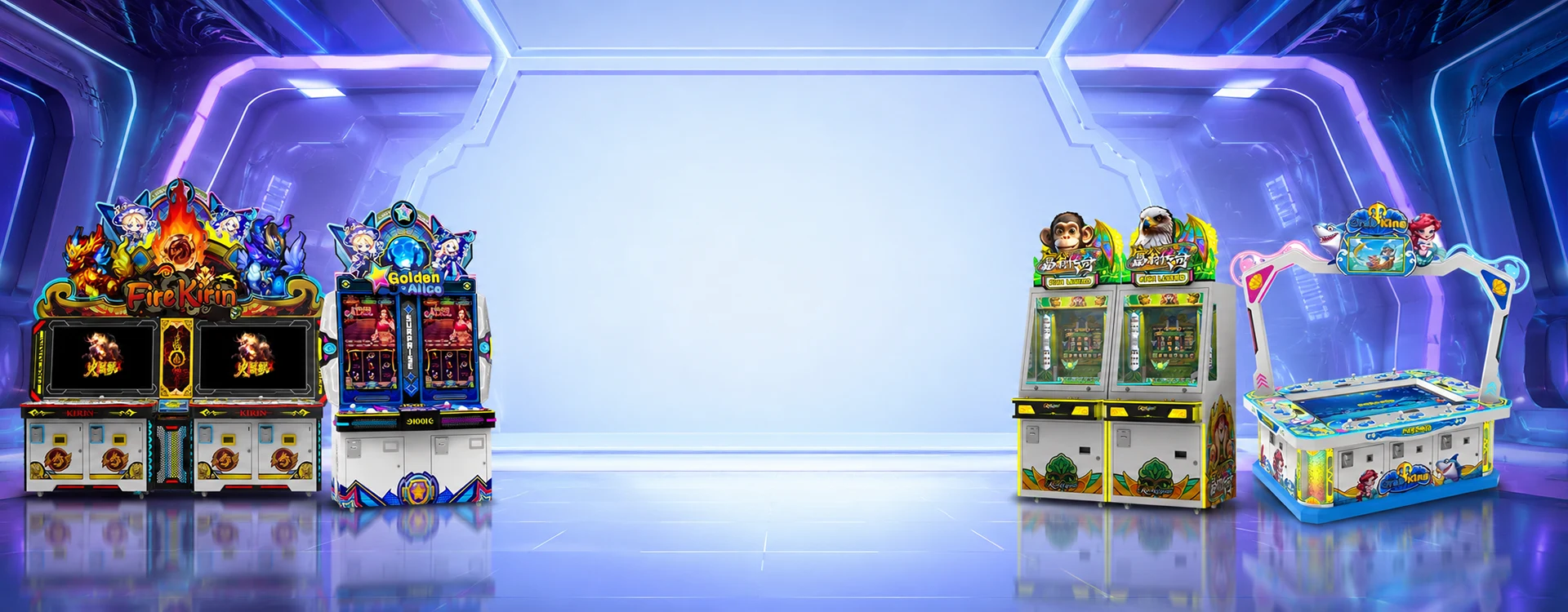
Buying a commercial arcade machine is not the same as choosing a game for personal use. A venue operator needs equipment that fits the floor, attracts the intended audience, supports repeat play, and can be maintained during daily operation. The best machine is therefore not always the largest cabinet or the game with the most visual effects. It is the machine that fits the venue’s commercial plan.
This guide presents a practical decision framework for arcades, family entertainment centers, shopping-mall entertainment areas, casino-style amusement venues, and other licensed entertainment establishments. It uses examples from the Chengde Amusement product range so buyers can compare real cabinet formats rather than abstract categories.
1. Define the audience before selecting the machine
Begin with the people you expect to play. Age range, group size, visit purpose, and average time in the venue all affect the right game mix.
| Audience or venue goal | Useful machine format | Examples to evaluate |
|---|---|---|
| Groups looking for social competition | Four-player, six-player, or eight-player cabinets | Fire Kirin 8 players, Crocodile Tycoon 2 |
| Players who enjoy physical, visible mechanisms | Coin pusher or ball drop machines | Rich Legend Coin Pusher, X CHROMA |
| Ticket and prize-oriented venues | Redemption and ticket arcade games | Happy Fruits, The West’s Treasure |
| Competitive skill-focused play | Skill game machines with clear player interaction | BATTING PIONEER, 1001 Night |
A family entertainment center may prioritize approachable redemption play and visible outcomes. A destination arcade may support larger multiplayer attractions. A compact mall location may need a smaller number of high-visibility cabinets with carefully planned circulation space.
2. Measure the usable floor area, not only the empty floor
Cabinet dimensions are only the starting point. Add space for player positions, queuing, staff access, opening service panels, cleaning, and emergency circulation. A machine that physically fits against a wall may still be unsuitable if players block a walkway or technicians cannot reach a service area.
For example, the Fire Kirin 4 players is listed as a vertical dual-screen four-player configuration measuring 2450 × 968 × 2517 mm per unit. The tabletop horizontal Fire Kirin 8 players is listed at 2198 × 1570 × 2449 mm. The eight-player version has a deeper footprint and requires circulation around more player positions, even though its nominal width is lower.
3. Check electrical capacity and installation conditions
Record the voltage, rated power, plug type, and intended number of machines. Do not plan only for the total rated wattage; consult a qualified local electrician about circuit loading, start-up behavior, grounding, surge protection, and regional electrical requirements.
The product range illustrates why this matters. Rich Legend is listed at 220V / 319W / 1.45A, while Crocodile Tycoon 2 is listed at 220V / 880W / 4A. Happy Fruits is listed at 220V / 1232W / 5.6A. A mixed floor can therefore place very different demands on the electrical plan.
4. Match player capacity to expected traffic
More player positions can increase social energy and simultaneous capacity, but only when the venue can regularly fill those positions. An eight-player machine in a low-traffic location may feel empty. A two-player or four-player machine can create a stronger experience in a smaller venue and may be easier to place.
- Two-player: suitable for paired play and narrower operating zones.
- Four-player: a flexible format for small groups and many commercial floors.
- Six- or eight-player: useful where peak traffic, group visits, and spectator visibility justify a larger attraction.
5. Build a balanced game mix
A resilient arcade floor usually gives visitors more than one reason to stay. Rather than filling the venue with minor variations of one game type, combine complementary experiences:
- A visually prominent multiplayer attraction that is easy to notice from a distance.
- A physical-mechanism game such as a coin pusher or ball drop cabinet.
- A skill or competitive game that creates a different play rhythm.
- Redemption or ticket games aligned with the venue’s prize and payout model.
This mix helps serve groups with different preferences and makes it easier to rotate or expand the floor later.
6. Evaluate serviceability and operating support
Before buying, ask what the supplier provides beyond the cabinet. Important questions include spare parts availability, remote troubleshooting, installation documentation, software and hardware configuration, warranty scope, packaging, shipping dimensions, and the process for diagnosing faults.
Also ask staff how often the machine requires cleaning, replenishment, calibration, or access to internal parts. A cabinet can look attractive in a catalog but still create operational friction if routine service does not match your staffing model.
7. Compare total project fit—not a promised return
No responsible supplier can guarantee revenue without knowing the venue, pricing, traffic, local rules, prize cost, operating hours, and machine uptime. Build your own forecast with conservative assumptions. Include purchase cost, freight, taxes, installation, electrical work, floor preparation, payment or token systems, prize or ticket cost, maintenance, and downtime.
Use trial periods or phased purchasing when possible. A small first order can validate audience response and operating requirements before a larger floor rollout.
Commercial arcade machine buyer checklist
- Define the target players and the experience the venue should deliver.
- Measure cabinet space, player space, queue space, and service clearance.
- Verify voltage, power, plug, grounding, and local electrical compliance.
- Choose player capacity based on realistic traffic, not maximum capacity alone.
- Balance multiplayer, physical-mechanism, skill, and redemption formats.
- Confirm warranty, spare parts, remote support, packaging, and shipping details.
- Model total project cost and test assumptions with conservative traffic data.
Frequently asked questions
What arcade machine is best for a new venue?
There is no universal best machine. A new venue should start with a balanced mix sized to its audience, floor space, electrical capacity, and staffing. Four-player cabinets are often flexible, while a larger multiplayer centerpiece can work when traffic and space support it.
How many arcade machines should I buy first?
Base the first order on the usable floor plan and a conservative demand forecast. Many operators reduce risk by opening with a focused mix and expanding after observing play patterns, uptime, and maintenance needs.
Should I choose redemption games or skill games?
Choose according to the venue model. Redemption games fit locations built around tickets or prizes. Skill games can attract competitive players and add variety. Many commercial floors use both.
What information should I send an arcade machine supplier?
Send your country, venue type, available floor dimensions, target audience, expected opening date, preferred game categories, quantity, voltage requirements, and delivery location. This allows the supplier to recommend configurations and prepare a more accurate quotation.
Related buyer resources
Continue with the commercial coin pusher buying guide, compare Fire Kirin 4-player and 8-player formats, or use the redemption machine selection guide to plan a category mix.
Specification note: Product examples and specifications in this guide are based on the published Chengde Amusement product pages as of August 20, 2026. Confirm the final configuration, dimensions, electrical requirements, and local compliance needs before purchase.