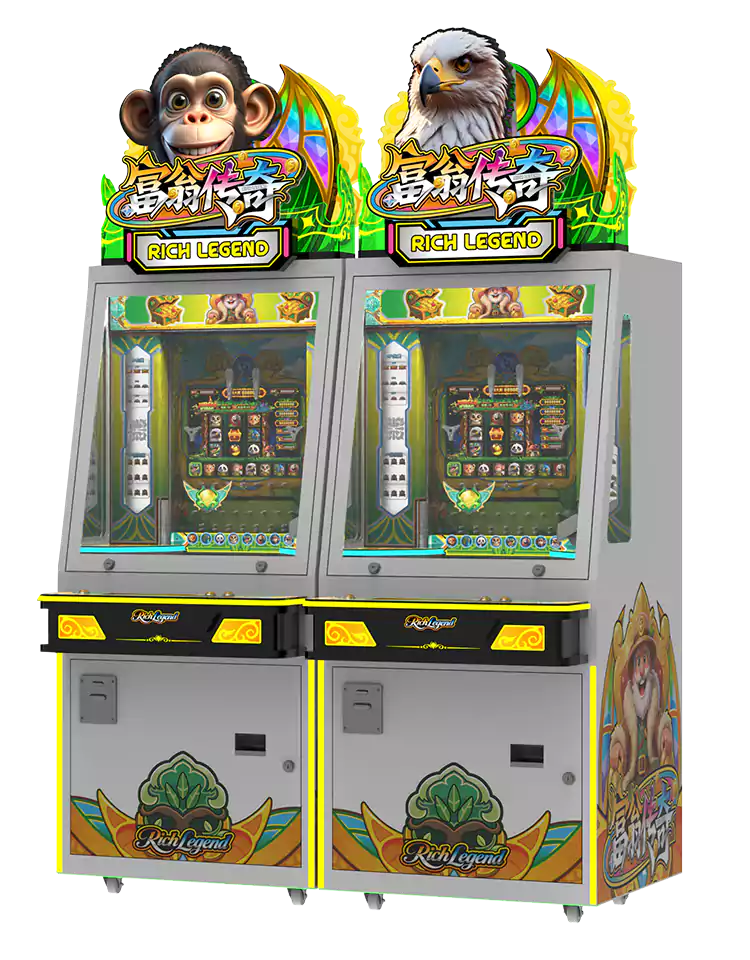
Coin pusher machines combine a physical mechanism with an outcome players can watch in real time. That visibility can make the category easy to understand for first-time visitors and engaging for spectators. For an operator, however, the purchase decision involves more than cabinet appearance. Floor planning, operating rules, coin or token handling, maintenance access, and local compliance all affect whether a machine fits the venue.
This guide uses the Rich Legend commercial coin pusher machine as a concrete example. Its published product page lists a vertical four-player or five-player configuration, dimensions of 2200 × 1020 × 680 mm per unit, and a 220V / 319W / 1.45A power supply. Final specifications should always be reconfirmed for the ordered configuration.
What is a commercial coin pusher machine?
A commercial coin pusher is an arcade cabinet in which players interact with a moving platform and visible coin flow. The cabinet’s physical action is a central part of the experience. Commercial models are designed for repeated daily use, multiple player positions, operator access, lighting, and integration with the venue’s chosen operating model.
The machine must be operated only where the game format is legal and properly licensed. Rules concerning coins, tokens, tickets, prizes, payouts, and age restrictions vary by country and region. Buyers should review local requirements before selecting a configuration.
1. Start with player capacity
A four-player or five-player configuration can support social play while using one shared attraction. The correct number of positions depends on traffic and floor shape.
- Choose more positions when the venue regularly receives groups and can maintain circulation around the cabinet.
- Choose fewer positions when floor area is limited or traffic is spread evenly through the day.
- Check sightlines so every player can see the active mechanism and understand the result.
Do not assume that more player stations automatically produce better performance. Empty positions can reduce energy, while a properly sized cabinet can appear active and inviting.
2. Plan the real operating footprint
The published cabinet size does not include every operational clearance. Your layout should include space for players, onlookers, staff, cleaning, and service-panel access. If the cabinet is installed near another game, make sure users do not compete for the same standing area.
| Layout item | What to confirm | Why it matters |
|---|---|---|
| Cabinet dimensions | Final assembled size for the selected configuration | Determines whether the machine physically fits |
| Player zone | Standing or seating space at every station | Prevents blocked aisles and uncomfortable play |
| Service access | Door swing, internal access, coin path, and control access | Reduces time required for routine service |
| Delivery route | Door width, elevator capacity, turning radius, and loading access | A cabinet that fits the floor may not fit the route into the venue |
3. Verify power and site preparation
Rich Legend is published with a 220V / 319W / 1.45A specification. Treat this as a product-page reference, not a substitute for an installation plan. Ask for the final electrical label, plug requirement, grounding guidance, and any recommendations for surge protection. A qualified local electrician should confirm that the venue circuits are appropriate for the complete machine mix.
4. Review the operating model
Before ordering, define exactly how the machine will operate in your jurisdiction and venue:
- Will players use coins, tokens, credits, cards, or another approved input?
- Will the venue use tickets or prizes, and how will those costs be controlled?
- How will staff open, refill, reconcile, and clean the machine?
- Which settings can the operator manage, and which settings require supplier support?
- What local amusement, gaming, consumer, electrical, and safety rules apply?
These questions should be resolved before shipment. Retrofitting a payment or operating system after delivery can add cost and delay.
5. Inspect visibility and player communication
A strong coin pusher cabinet should make the physical action visible. Players need to understand where to focus and what their interaction affects. Lighting can improve visibility, but it should not hide the mechanism with glare. Labels and controls should be easy to understand in the target market.
Ask the supplier for cabinet videos, close-up images, control layouts, and gameplay footage. If localization is required, confirm language and artwork options in writing.
6. Ask about maintenance and spare parts
Physical-mechanism games benefit from a clear maintenance plan. Discuss routine cleaning, moving parts, sensors, coin paths, wear components, diagnostic procedures, and recommended spares. Request a list of parts that venue staff can replace and identify tasks that require a technician.
For overseas purchases, the speed and clarity of remote support can be as important as the warranty period. Ask how troubleshooting is handled across time zones and what photos, videos, or error information the technical team will require.
7. Compare coin pushers with other physical-mechanism games
| Machine category | Primary visible action | Typical reason to consider it |
|---|---|---|
| Coin pusher machine | Moving platform and coin flow | Familiar physical action and multiplayer visibility |
| Ball drop arcade machine | Rolling or dropping ball | Clear physical event and center-island presentation |
| Ball drop redemption machine | Top pinball drop and multiplayer interaction | Larger six-player attraction for high-traffic floors |
The categories can complement each other. The right choice depends on whether the venue needs a compact familiar mechanism, a center-island visual feature, or a larger multiplayer attraction.
Questions to ask a coin pusher machine supplier
- What is the exact assembled size and weight of my selected configuration?
- How many player stations are included, and can the configuration change?
- What voltage, frequency, plug, rated power, and grounding are required?
- Which payment, token, ticket, or card systems are supported?
- Which parts should be ordered as initial spares?
- What documentation, installation guidance, and remote support are included?
- How is the cabinet packed, and what are the shipping dimensions and weight?
- Which settings and artwork can be localized for the target market?
Frequently asked questions
How much space does a commercial coin pusher need?
Use the assembled cabinet dimensions plus player zones, spectator space, service access, and required circulation. Rich Legend is published at 2200 × 1020 × 680 mm per unit, but buyers should request a final installation drawing for the ordered four-player or five-player configuration.
How many players should a coin pusher support?
Choose capacity based on realistic peak traffic. Four or five positions can support group play, but only if the venue has enough surrounding space and demand to use them.
What maintenance does a coin pusher require?
Maintenance typically includes cleaning visible surfaces and coin paths, inspecting moving parts and sensors, checking controls, and following the manufacturer’s service schedule. Exact tasks depend on the model and operating system.
Can a coin pusher machine be used in every country?
No. Laws and licensing rules differ. The operator must confirm whether the selected coin, token, ticket, prize, or payout configuration is permitted in the intended location.
Related buyer resources
For broader project planning, read how to choose arcade machines for a venue. To compare coin pushers with a wider redemption portfolio, use the arcade redemption machine selection guide.
Buyer note: Published specifications are useful for shortlisting, but the purchase order should reference a confirmed configuration sheet, packing details, electrical requirements, warranty terms, and local compliance responsibilities.